The Fish Tank That Breached a Casino
In 2017, a smart fish tank thermometer became the entry point for one of the most memorable network breaches in cybersecurity history. Here's what actually happened.
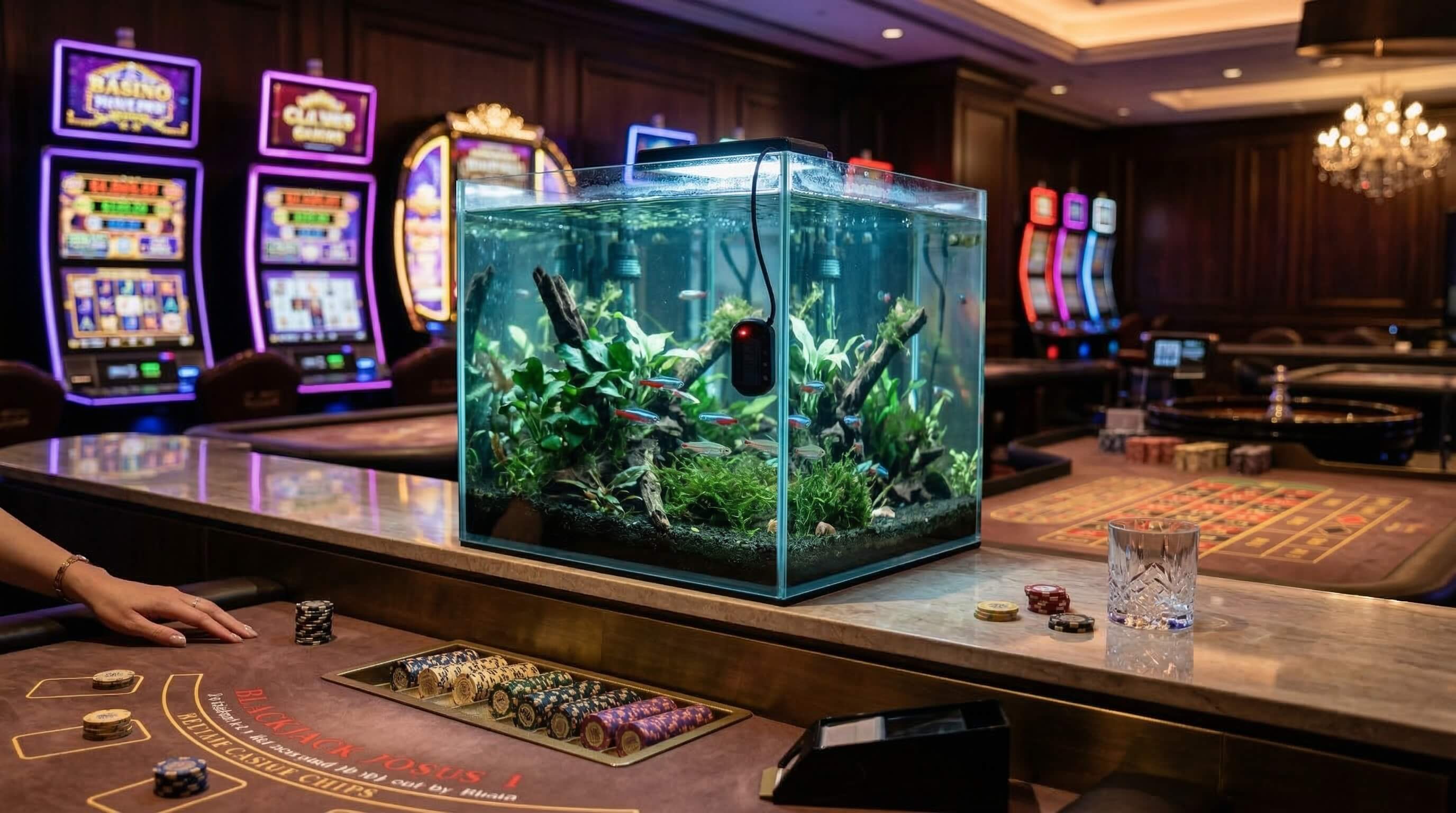
In 2017, an unnamed North American casino was breached through its fish tank.
Not metaphorically. Not through a social engineering attack that used an aquarium as cover. Through the actual fish tank — a smart, internet-connected thermometer that monitored the water temperature and feeding schedule of a lobby installation. Attackers compromised the device, used it to scan the internal network, found a path to a database, and exfiltrated approximately 10GB of data to a server in Finland. The destination was notable: Darktrace, the British AI security firm that detected the breach, flagged it as a "rare external destination" — an IP address that no other device on the network had ever contacted.
It is the most-cited anecdote in IoT security. It has appeared in academic curricula, regulatory filings, conference keynotes, and Bruce Schneier's 2018 book. It is the example that made network engineers look at their smart coffee machine and wonder.
What Darktrace actually reported
The incident appeared as Case Study #6 in Darktrace's Global Threat Report 2017, published in July of that year. The casino had taken a precaution most wouldn't bother with: the fish tank was connected to the corporate network via a dedicated VPN, designed to isolate it from everything else. The segmentation failed. Once inside the thermometer, the attackers scanned, found additional vulnerabilities, and moved laterally until they reached something worth stealing.
Darktrace's Director of Cyber Intelligence, Justin Fier, told CNN at the time: "Someone used the fish tank to get into the network, and once they were in the fish tank, they scanned and found other vulnerabilities and moved laterally to other places." The firm's anomaly detection system caught the breach based on four signals: the destination IP was unknown to every other device on the network, it was located in Finland, the data volume was far beyond anything a thermometer should produce, and the exfiltration used a protocol normally associated with audio and video streaming — a deliberate attempt to disguise the traffic as something ordinary.
The story got a second, louder retelling in April 2018, when Darktrace CEO Nicole Eagan recounted it at the Wall Street Journal CEO Council Conference in London. This is the version most people know. It was here that the "high-roller database" detail appeared — the claim that the attackers specifically located and exfiltrated a list of the casino's biggest spenders. That detail is not in the original 2017 report. Darktrace's platform monitors network behavior and metadata; it does not read file contents. In the original disclosure, Fier had explicitly said: "Darktrace doesn't look at the content of files, so we don't know" what was actually taken.
"The high-roller database makes the story better. It also cannot be verified."
The part that gets quietly omitted
The casino was never named. The thermometer brand was never disclosed. The vulnerability exploited was never specified. The entire story rests on a single source — Darktrace — a commercial vendor whose business is selling the exact type of anomaly detection system that caught this breach. Darktrace has since removed the original report from its website. It is now available only through the Wayback Machine.
At least one IoT security expert, consulted by the cybersecurity blog Rootcat for a detailed examination of the case, concluded the incident was "very unlikely based on the capabilities of fish tank salinity sensors during that time." The expert added, almost in the same breath: "even though he thinks this story is not true, the story itself is too good and happens like this all the time, only with just some other IoT device."
That last sentence is doing a lot of work.
Because the specific attack — a thermometer in a specific lobby, in an unnamed casino, exfiltrating data to Finland — has never been independently confirmed. But every security principle the story illustrates has been validated, repeatedly, by incidents that were confirmed. In 2016, Mirai compromised hundreds of thousands of IoT devices — cameras, routers, printers — and used them to execute one of the largest DDoS attacks in internet history. Robert Hannigan, former head of GCHQ, appeared alongside Eagan at the same 2018 conference and noted that he had personally seen a bank breached through its CCTV cameras. The fish tank hack may or may not be precisely as described. The attack vector it describes is real.
Why it stuck
Security people tell this story because it makes a technical argument viscerally legible to people who do not read CVE reports.
The underlying lesson is not complicated: any device with an IP address and a connection to a network is a potential entry point. In 2017, Gartner projected over 20 billion connected devices by 2020. The attack surface of any organization had expanded far beyond servers and workstations, into thermostats and badge readers and lobby aquariums, and most of those devices were running firmware nobody had audited, with credentials nobody had changed from the factory defaults, on networks that had never been designed to treat them as threats.
The fish tank thermometer is just a dependency that nobody thought to check.
Developers understand this instinctively. You know what happens when you pull in a library without reading it. You know what happens when you connect a service to the main network because it was easier than setting up proper segmentation. You know that the attack surface of a system is not the perimeter you intended — it is the perimeter that actually exists, which is usually larger, messier, and full of things nobody put on the architecture diagram.
The casino's security team had the right instinct — they put the fish tank on a VPN. The segmentation just wasn't tight enough. The device they treated as decorative infrastructure turned out to be a component with a network interface, and components with network interfaces get exploited.
What changed afterward
The fish tank hack became a fixture in IoT security education precisely because it arrived at the right moment. 2017 was the year the industry was trying to convince organizations that IoT devices were not a novelty problem — they were an enterprise security problem that was scaling faster than any mitigation. A conference anecdote about a fish tank accomplished in one telling what years of dry vendor whitepapers had not.
In the US, the IoT Cybersecurity Improvement Act passed in 2020, mandating NIST to develop security standards for government-purchased IoT devices. NIST SP 800-213 and the NISTIR 8259 series followed. In Nevada specifically, the Gaming Commission adopted Regulation 5.260 in December 2022, requiring gaming licensees to conduct cybersecurity risk assessments, designate qualified security personnel, and report attacks within 72 hours. The fish tank was not the only catalyst — the 2023 MGM and Caesars ransomware attacks accelerated the timeline — but it was part of the vocabulary that made the regulation legible.
Bruce Schneier, who cited the incident in Click Here to Kill Everybody, made the argument plainly: "Vulnerabilities in one thing can affect another thing." The market cannot self-correct for IoT insecurity because the cost of an insecure device is borne by the victim, not the manufacturer. The fish tank thermometer worked fine. The fish were fine. The casino's data was not.
The lesson that actually transfers
Whether the high-roller database detail is accurate or embellished, whether the specific thermometer could technically have supported the described attack chain, whether the entire incident happened exactly as Darktrace reported — none of that changes the principle.
The devices you think are decorative still have IP addresses. The network segment you thought was isolated still has failure modes. The dependency you didn't audit is still running. Someone is scanning.
Security is not a perimeter problem. It is an inventory problem. You cannot defend what you haven't counted.
That's not a fish tank problem. That's an architecture problem. And architecture problems are exactly the kind of thing that gets introduced at 3am, in a sprint that was supposed to be simple, by a deploy that seemed fine.
ByteWear makes developer apparel for people who've seen enough bad code to have opinions about it.